
Forklift-rated coatings, dust control and aisle marking for Oakville warehouses, distribution centres and 3PL facilities. Large-area pricing from $1.50 per square foot, installed in phases so the building keeps shipping.
Free on-site assessment anywhere in Oakville, written scope, fixed price. No obligation, and no pressure if the answer is not this quarter.
A warehouse floor rarely fails dramatically. It just gets slowly more expensive, in places that never get attributed back to it.
Weak surface paste ground off by wheels lands on inventory, in conveyor bearings and in your HVAC filters. You pay for that in sweeping labour, in filter changes and occasionally in a rejected shipment.
Abrasive concrete dust works into wheels, bearings and seals. The floor is the cause and the forklift budget takes the invoice.
Once a joint edge starts to spall, every pallet jack crossing it makes it worse, and the repair moves from a filler to a saw-cut and pour.
Customer audits, insurers and prospective tenants all read the floor first. It is the largest single surface in your building and the easiest thing to judge you on.
Oakville makes this worse in two specific ways. The QEW corridor buildings are old enough to dust badly, and the north-end buildings are new enough that the concrete is still releasing moisture, which is the fastest way to lose a coating you just paid for.
Sealing the slab is usually the cheapest operational improvement available to you.
Oakville's distribution stock splits neatly in two. The QEW East, QEW West and Burloak districts are mature and close to fully built out, with slabs from the 1970s through the 1990s that were poured before under-slab vapour retarders were normal practice. The north Oakville and Highway 407 lands are the newer inventory, where flatness tolerances are tighter and the constraint is green concrete rather than old concrete. Both need testing before anyone quotes, and both benefit from being coated in phases, because none of these buildings can stop shipping for a week.
Most requested in Oakville: dust control and aisle striping across occupied buildings.
South Oakville's employment districts are mature and close to fully built out, so we see a lot of 1970s to 1990s slabs poured before under-slab vapour retarders were standard. North Oakville and the Highway 407 lands are the opposite problem: new concrete that is still giving off moisture. Either way we test before we quote.
The other thing worth knowing about Oakville distribution buildings is that a lot of them are leased, which changes the conversation. Landlords care about what happens at the end of term, tenants care about the next five years, and a coating is a leasehold improvement that outlives most leases. We are used to quoting both sides of that: a full system where the tenant is committed, and a densified and sealed slab where they are not. The second option is a fraction of the price and it still stops the dusting, which is usually the actual complaint.
The most common mistake in a warehouse is a thin roll-applied coating sold into a heavy forklift application. It looks identical on day one and it is gone in eighteen months. Thickness bands are not marketing, they are the spec.
| System | Where it goes | Why it gets specified |
|---|---|---|
| Thin-mil roll coat, 11 to 25 mils | Mezzanines, storage bays, light pedestrian and pallet-jack areas | Honest description from the manufacturer: basic protection in light traffic. Fine where it belongs, wrong under a counterbalance forklift. |
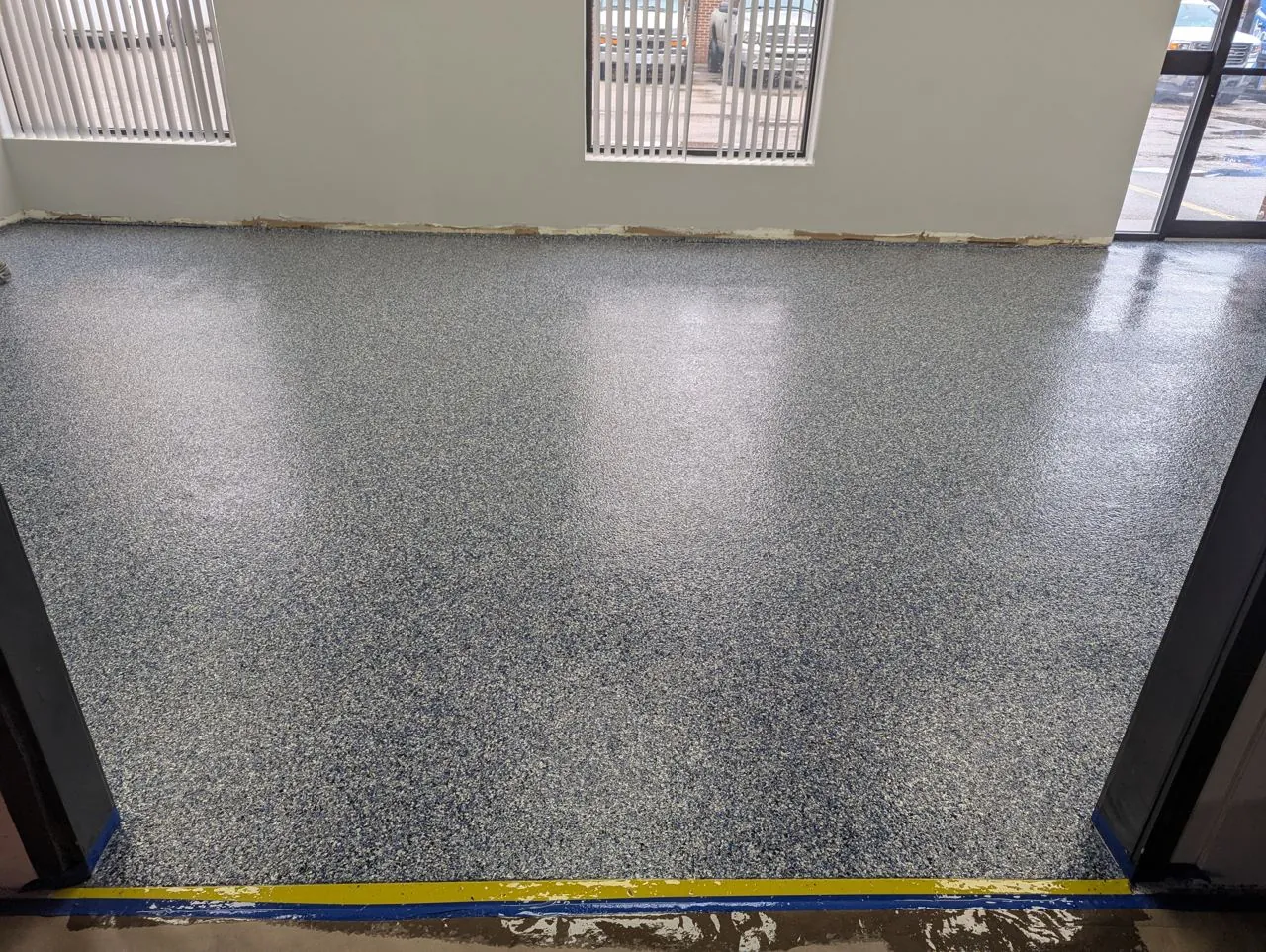
| High-build epoxy, 20 to 250 mils | General racking aisles, staging, pick and pack | The working band for most distribution floors. Multi-coat build with a chemical and abrasion resistant topcoat. |
| Aggregate-filled mortar, 1/4 in and up | Dock aprons, battery rooms, turn zones, heavy machinery | 375 mils and up is the standard call for heavily laden forklift traffic. Published urethane mortar data runs about 7,800 psi compressive on ASTM C579 with 30 mg loss on ASTM D4060 Taber abrasion at 1,000 cycles. |
| Moisture mitigation primer | Slab-on-grade with no vapour retarder | The difference between a ten year floor and a delaminated one. Not optional on older stock. |
| Line striping and safety marking | Aisles, walkways, hazard zones, dock positions | Applied as part of the system so the lines wear at the same rate as the floor instead of peeling off it. |
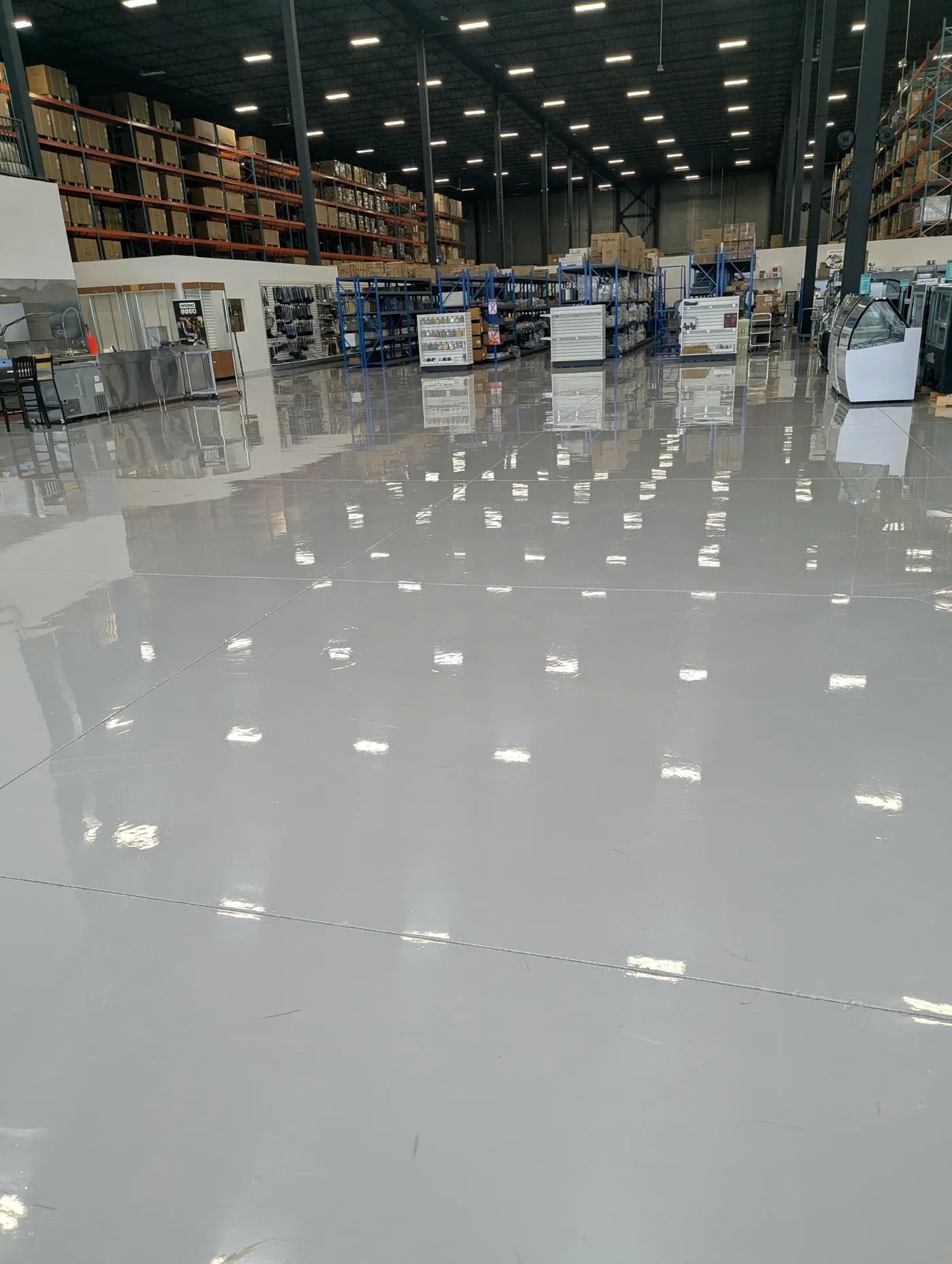
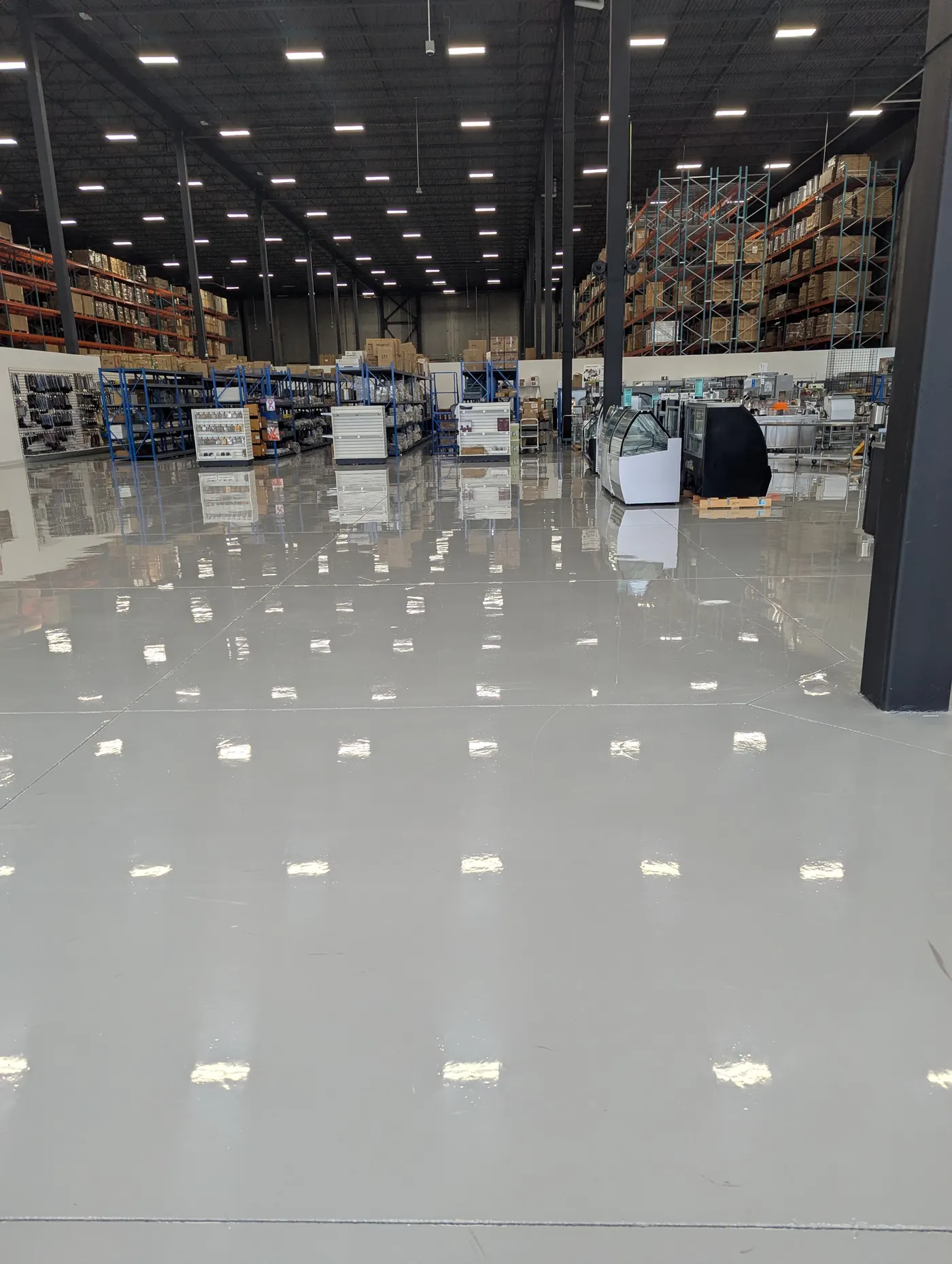
A bare or worn warehouse slab dusts because the top few millimetres of paste are weak: bleed water worked into the surface, curing cut short, then carbonation. Forklift wheels and pallet jacks grind it into powder that lands on your inventory, gets into conveyor bearings and racking, wears forklift components and loads your HVAC filters. Sealing it is usually the cheapest operational fix in the building.
Request a Site VisitWe run ASTM F1869 calcium chloride and ASTM F2170 in-situ relative humidity before specifying. Most resinous manufacturers want under 3 lb per 1,000 sq ft per 24 hours on F1869 and under 80% RH on F2170, with probes at 40% of slab depth and service conditions set 48 hours ahead. Those two tests do not correlate and cannot be converted into each other, which is why we run both on questionable slabs.
Read the GuidesWe coat in bays and aisles, protect racking, and schedule around inbound and outbound windows including nights and weekends. Fast-cure polyaspartic topcoats bring equipment back onto the floor in as little as 4 hours, so a Saturday section can be racked again by Sunday.
Get Large-Area PricingBook the free on-site assessment. We test the slab, write the scope and give you a fixed price. Finding out costs you an hour and commits you to nothing.
Prep is selected against ICRI 310.2R concrete surface profiles CSP 1 to 10. Thicker system, coarser profile. Shot blasting and diamond grinding, never acid etching.
Trucks track brine and slush inside all winter. The apron and the first twenty feet of drive aisle take the abuse, so they get the heavier build.
Colour convention follows ANSI Z535.1, where red reads as danger and yellow as caution. Note that OSHA is US law and does not apply here: Ontario sites sit under the OHSA and O. Reg. 851.
We coat around installed racking, cove into post bases and seal the interface rather than stopping the coating short.
Saw-cut and construction joints are filled with semi-rigid filler where forklift wheels need support, and left to move where they need to move.
Not every warehouse needs a full system. Sometimes densifying and sealing the slab is the right answer, and we will say so.
Oakville splits into two working realities. South of Dundas the buildings are older, tenanted and busy, so access, parking and elevator or dock time drive the schedule as much as the coating does. North of Dundas and out toward Highway 407 the buildings are newer, easier to work in, and the constraint is usually concrete that has not finished drying. We quote them differently because they are different jobs.
We come out, measure, take moisture readings and look at what the floor has been through. On south Oakville stock we assume no vapour retarder until testing says otherwise.
The quote states the system, the build thickness, the preparation method and the phasing plan, so you know which areas go down on which nights before you sign anything.
Nights, weekends and shutdown windows, sectioned so the building keeps working. Fast-cure topcoats put traffic back on a finished section in as little as 4 hours.
Twenty-seven Google reviews, a 5.0 average, and Christopher replies to every one of them personally. He is also the person who will be standing on your floor, which is not true of most companies quoting this work.
"I had the pleasure of working with Surface Coating Experts, owned by Christopher, on a project in our condominium where one of the balconies and walkways required a complete repair."
What customers mention most: garage floor installation, epoxy quality, detailed work, and a smooth process from first quote to finished floor.
Every review gets a personal reply from the owner - the after-the-job care that keeps the rating a perfect 5.0.
This is not a sales call with a clipboard. An Oakville building is either mature south-end stock with a slab poured before vapour retarders were standard, or a newer north-end build where the concrete has not finished drying, and those need opposite answers. The assessment is how we find out which one you have before anybody quotes a number.
Free. No obligation. Usually within the week.
Prefer to talk it through? Call (905) 876-6957, Monday to Saturday, 6am to 6pm.
Tell us where the floor is and what runs on it. We will come out, test it and put a fixed price in writing.
Same service nearby: Warehousing in Burlington · Warehousing in Hamilton
Shutdown and long-weekend windows across Oakville's industrial districts get spoken for well ahead, so if you are aiming at a particular weekend, start the conversation early rather than late. And if the slab tests wet, moisture mitigation adds material lead time. Neither is a reason to rush a decision, both are reasons to get the testing done now while it costs you nothing.
Also see our industrial & commercial overview, epoxy flooring in Oakville and published pricing.
Tell us the square footage, what runs on the floor and when the building can be quiet. We come out, test the slab and put the scope and the sequence in writing.
Free, no obligation, and you keep the written scope whether you use us or not.