
Chemical, impact and thermal resistant systems for Hamilton manufacturing plants, machine shops, metal fabricators and process facilities. Specified against what actually lands on your floor, not against a generic brochure.
Free on-site assessment across Hamilton, Stoney Creek, Ancaster, Dundas and Mount Hope. Written scope, fixed price, no obligation.
Plant floors do not send you an invoice. They just show up as housekeeping hours, maintenance costs and, eventually, a repair that has to happen during production.
Etched, softened or discoloured concrete has lost its top layer. That layer does not grow back, and the next spill goes deeper than the last one.
Porous, contaminated concrete holds oil and coolant no matter how often it is cleaned. That is a labour cost with no end date attached to it.
A system laid over a shake-on hardener, over slab moisture or over contamination lets go inside two years. Removing the failed coating then costs more than proper preparation would have in the first place.
Traffic segregation, contamination control and housekeeping all get scored, and the floor is the visible evidence for all three.
Hamilton is where we get called to fix somebody else's failed floor most often, and the pattern almost never varies: a coating laid over a shake-on hardener, or over moisture, or over contamination a surface grind never reached. Removing it costs more than preparing the bare slab would have.
The expensive floor is the one you end up doing twice.
Hamilton's Bayfront Industrial Area covers roughly 3,700 acres and supports over 18,000 jobs, described by the city as a cornerstone of Ontario's heavy manufacturing sector and particularly steel. ArcelorMittal Dofasco is operating and running a major decarbonisation project, and Stelco is now owned by Cleveland-Cliffs. Around those anchors sits a deep base of fabricators, coaters, machine shops and service suppliers, most of them in mid-century buildings. Those slabs typically have no vapour retarder, a shake-on hardener that has to come off, and decades of oil in them. It is the most demanding preparation work we do, and it is why we bond test in Hamilton more often than anywhere else.
Most requested in Hamilton: heavy-build mortar systems and thermal zone rebuilds.
Hamilton has the oldest industrial building stock of the three. Bayfront and East Hamilton slabs are frequently mid-century, poured without a vapour retarder, finished with a shake-on hardener and carrying decades of oil and coolant. That is a prep problem before it is a coating problem. Red Hill, Ancaster and the airport lands are newer and far more straightforward.
Hamilton is also where we most often get asked to fix somebody else's failed floor, and the pattern is remarkably consistent. A coating went down over a shake-on hardener, or over a slab with no vapour retarder, or over contamination that a surface grind did not reach, and it let go within two years. Removing a failed coating costs more than preparing bare concrete would have, which is the expensive lesson in it. If you are getting quotes now, ask every contractor how they are testing the slab before they price it.
Every plant floor question comes back to the same three inputs: what gets spilled on it, how hot that spill is, and what rolls over it. We ask for the list first, then specify against the manufacturer's resistance chart for the exact system, which is the only place those answers actually live.
| System | Where it goes | Why it gets specified |
|---|---|---|
| Novolac epoxy | Acid handling, plating, battery rooms, chemical process bays | Published product data covers inorganic acids including 98% sulfuric, at 100% solids, with service to roughly 80°C. This is where standard bisphenol-A epoxy stops being the right answer. |
| Urethane cement mortar | Hot process, steam clean-down, foundry-adjacent, thermal cycling | Rated across roughly -40°F to 250°F with a 150°F-plus shock differential, and it moves at close to the same rate as the slab so it does not shear off under thermal cycling. |
| High-build epoxy with urethane topcoat | General production floors, assembly, packaging | The workhorse. Epoxy for build and adhesion, urethane or polyaspartic on top for abrasion, UV stability and faster return to service. |
| Static dissipative systems | Powder handling, solvent areas, electronics-adjacent lines | Where combustible dust or solvent vapour is in play, the floor becomes part of the grounding strategy rather than just a surface. |
| Machine plinth and base coving | Every equipment base, pit edge and pedestal | Coved up the plinth and sealed at the interface, so coolant and oil cannot get underneath the coating and lift it. |
A plant floor that has been running for twenty years has oil, coolant and hydraulic fluid driven down into the concrete. Grinding the surface alone does not solve that, it just exposes clean-looking concrete with contamination underneath waiting to reject the primer. Older stock needs degreasing, sometimes repeated, and a bond test before anything gets specified. This is the step most quotes skip and most failures come from.
Book a Site VisitThere is no such thing as a chemically resistant floor in general. There is a specific system with a specific resistance chart. Novolac extends the acid range, urethane handles solvent and thermal duty, standard epoxy has real limits. We ask what you run, then match the system and show you the data rather than promising broad resistance.
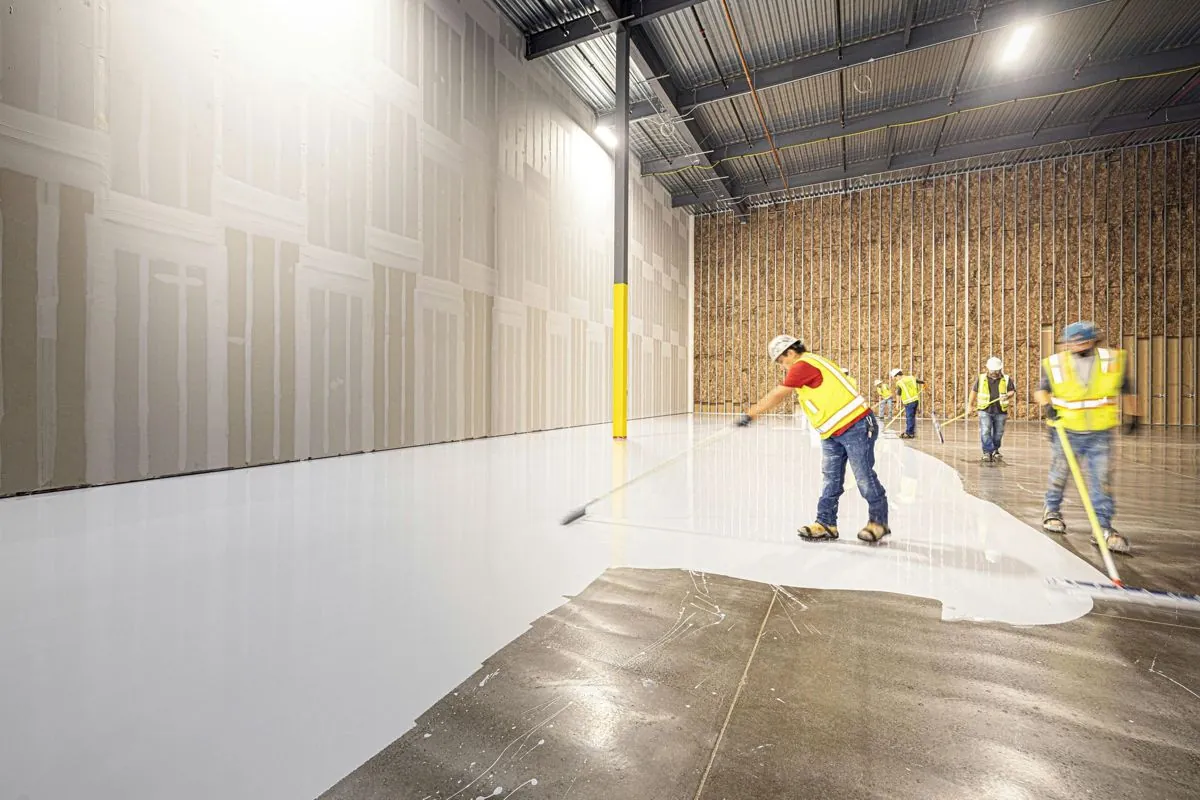
Read the GuidesWe work line by line and cell by cell, around fixed equipment and pits, on nights, weekends and shutdown windows. Fast-cure systems have equipment back on the floor within hours rather than days, and we coordinate with your millwrights on anything that has to be lifted or unbolted.
See PricingOn older Hamilton slabs the preparation is the whole variable, so we test before we price. Book the assessment and you get a fixed number rather than an estimate that moves once the grinder starts.
Aggregate-filled mortars at a quarter inch and up are the answer where dropped tooling and heavy point loads are routine, not a thicker roll coat.
Machining floors get a system chosen for the coolant chemistry in use, with texture that still grips when the floor is oily.
Ovens, quench areas, wash bays and anywhere the floor swings temperature get urethane cement rather than epoxy.
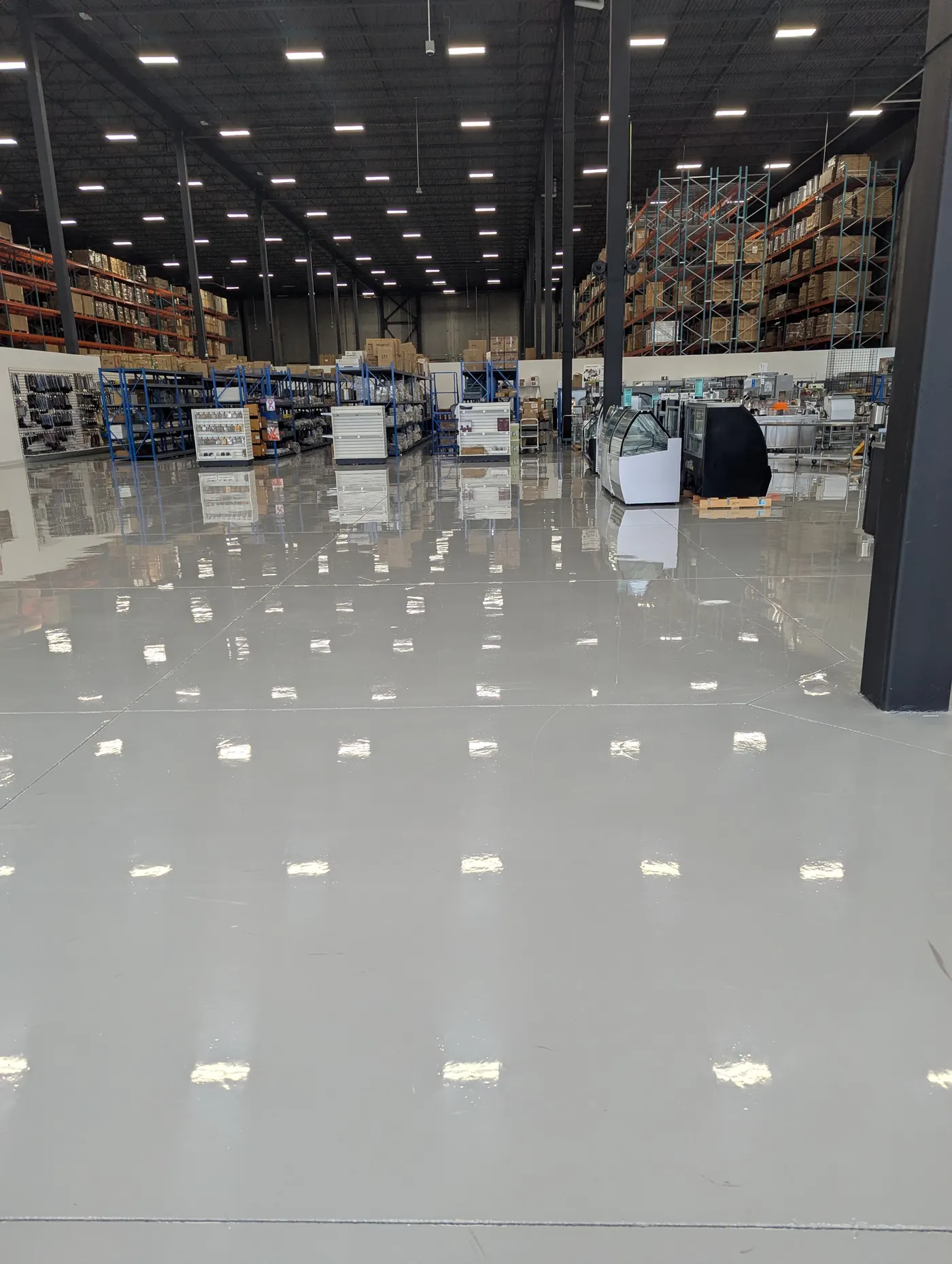
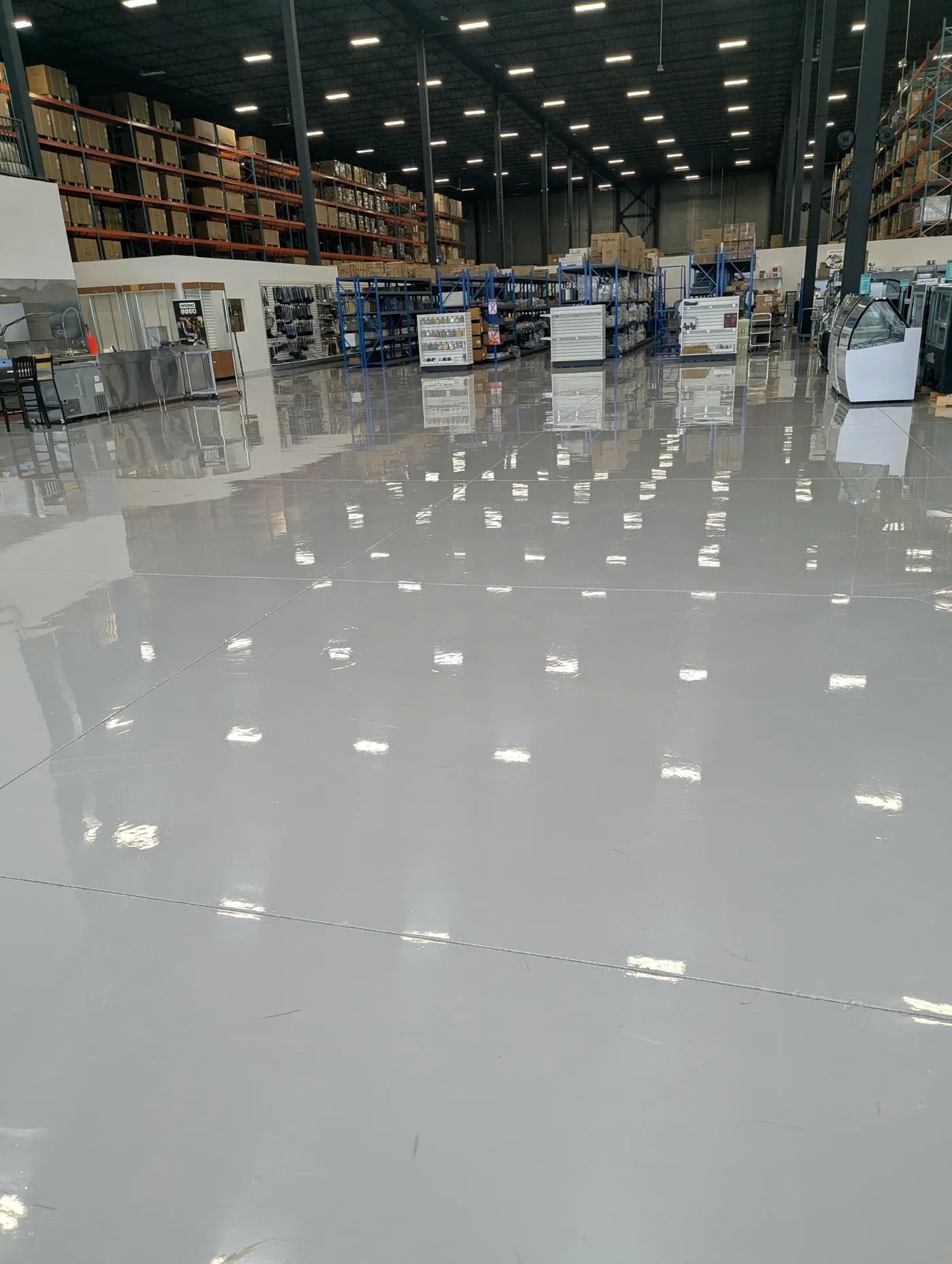
A sealed, seamless floor keeps grinding dust and swarf sweepable instead of ground into the slab.
Walkways, hazard zones, forklift routes and equipment footprints marked into the system per ANSI Z535.1 colour convention.
ASTM C579 compressive results carry roughly 15% reproducibility variance, so we do not sell you on a small psi gap between two products.
Hamilton jobs get more preparation time in the quote than anywhere else we work, and that is deliberate. The Bayfront and East Hamilton building stock is old, hard-used and frequently contaminated, and the honest way to price that is to test before quoting rather than discover it on day two. The Red Hill business parks, Ancaster and the Mount Hope airport lands are newer and much more predictable, and we price those accordingly rather than applying a Hamilton premium across the board.
Moisture testing, a bond test on contaminated slabs and a look for shake-on hardeners. On older Hamilton floors this is the difference between a real quote and a guess.
Degreasing, shot blasting and repair are itemised rather than buried, so you can see what you are paying for and why the cheap quote is cheap.
Bay by bay, line by line, on nights and weekends. Fast-cure systems return traffic to a finished section in as little as 4 hours.
Twenty-seven Google reviews, a 5.0 average, and Christopher replies to every one of them personally. On the kind of floors Hamilton has, an owner-operated crew that tests before it quotes is worth more than a bigger name.
"I had the pleasure of working with Surface Coating Experts, owned by Christopher, on a project in our condominium where one of the balconies and walkways required a complete repair."
What customers mention most: garage floor installation, epoxy quality, detailed work, and a smooth process from first quote to finished floor.
Every review gets a personal reply from the owner - the after-the-job care that keeps the rating a perfect 5.0.
This is not a sales call with a clipboard. Hamilton has the oldest industrial building stock we work in, and the honest way to quote a Bayfront or East Hamilton floor is to test it rather than look at it. That is why our Hamilton assessments take longer than most, and why our Hamilton prices tend to hold.
Free. No obligation. Usually within the week.
Prefer to talk it through? Call (905) 876-6957, Monday to Saturday, 6am to 6pm.
Tell us where the floor is and what runs on it. We will come out, test it and put a fixed price in writing.
Same service nearby: Manufacturing in Burlington · Manufacturing in Oakville
On older Hamilton slabs the preparation is the variable, and we would much rather find that at the assessment than halfway through your job. Second, plant, hangar and warehouse shutdown windows get booked early here. If you have a date in mind, the useful move is to get us in front of the floor well ahead of it.
Also see our industrial & commercial overview, epoxy flooring in Hamilton and published pricing.
Tell us the square footage, what runs on the floor and what has already been tried on it. On older Hamilton slabs we test before we price, so the number you get is the number.
Free, no obligation, and you keep the written scope whether you use us or not.