
Hangars, MRO shops, component facilities and aerospace suppliers in and around Burlington. Seamless, non-shedding, fluid-resistant floors specified around FOD control, hydraulic fluid exposure and hangar drainage.
Free on-site assessment, usually within days because we are based here in Burlington. Written scope, fixed price, no obligation.
In an aviation facility the floor is a contamination source and an audit item before it is a wearing surface, which changes what a failure actually costs.
Bare and worn concrete sheds continuously. In an aircraft environment that is not a housekeeping complaint, it is a risk item with your name on it.
Phosphate ester fluids will destroy an unsuitable coating. Recoating a hangar deck means clearing the bay, and clearing the bay is the real cost of getting it wrong.
Floor condition, contamination control and drainage all get looked at. Fixing them inside a corrective action window is the most expensive way to do this work.
A dark, patched, dusty floor turns every dropped fastener into a search, and every search into a delay.
In Burlington this shows up in precision shops sitting among the metal fabricators and electronics firms, where the floor is a dust source next to open machine ways and measurement equipment. That is a quality problem before it is a maintenance one.
Clearing a hangar bay twice costs considerably more than specifying it correctly once.
Aerospace is a real but secondary sector in Burlington, showing up in the supplier and precision manufacturing base rather than in hangars, and federal support has gone to at least one Burlington manufacturer to improve production for the aerospace sector. Those shops sit among the metal fabricators and electronics firms along Harvester Road, Mainway and the North Service Road, and the floor requirements tend to look more like precision manufacturing than aviation: seamless, non-shedding, resistant to cutting fluids and cleaners, and often static controlled where electronics assembly is part of the process.
Most requested in Burlington: precision shop floors with non-shedding and static control.
Harvester Road and the North Service Road stock dates to the 1960s through 1980s, which usually means a hard-troweled slab with no vapour retarder under it and decades of soaked-in product. The 407 Corridor and Bronte Creek Meadows are Burlington's newest inventory, where green concrete and slab moisture are the risk instead.
Burlington's aerospace suppliers are usually running precision work in a shared building, which puts dust control at the top of the list. Diamond grinding generates a lot of it, and in a shop with open machine ways and measurement equipment that is a genuine risk rather than a housekeeping inconvenience. We run extraction at the tool, hoard the work area with negative pressure where it matters and agree a clean handover boundary before we start. It slows the work down slightly and it is not optional.
In an aerospace facility the floor is a contamination source before it is a wearing surface. Bare or worn concrete dusts, tile lines trap debris, and both put foreign object debris where it should never be. A seamless, monolithic, coved system removes the source rather than managing it.
| System | Where it goes | Why it gets specified |
|---|---|---|
| High-build epoxy, hydraulic fluid resistant | Hangar decks, MRO bays, component shops | Phosphate ester hydraulic fluids such as Skydrol are aggressive to many organic coatings. Purpose-made hangar systems are marketed as resistant, and we insist on a written immersion statement from the manufacturer for your exposure before we specify one. |
| Static dissipative system | Fuelling areas, avionics, component assembly | FAA guidance for fuelling areas sits above 1.0 x 10⁶ ohms and below 1.0 x 10⁹ ohms. The system is a grounded assembly with a conductive grid, not just a coating. |
| Urethane cement | Wash bays, parts cleaning, thermal areas | Where washdown, solvent and temperature swing are routine, cementitious urethane outlasts epoxy by a wide margin. |
| Seamless coving and terminations | Wall junctions, hangar door thresholds, pit edges | No grout lines, no open joints, nothing for debris to sit in and nothing for a wash-down to drive under. |
| Line marking and jacking point layout | Aircraft positioning, walkways, hazard zones, jack points | Marked into the system so the layout stays legible under towing and tire scrub. |
Skydrol and other phosphate ester hydraulic fluids will destroy the wrong coating. Manufacturers market hangar systems as Skydrol resistant, but that claim is usually marketing copy with no public immersion data attached. Before we specify anything for an MRO bay we require a written resistance statement from the manufacturer covering your actual fluids and dwell times. If they will not put it in writing, we do not use it.
Book a ConsultationNFPA 409 classes hangars by door height and fire area, with Group I covering doors over 28 feet or fire areas over 40,000 square feet and Group II covering 5,001 to 40,000 square feet. It requires aprons adjacent to access doors to slope away from the hangar, a trench drain running parallel to the access doors to catch spilled fuel before it reaches the apron, and drainage sized so nothing builds up when every fire protection system and hose stream is discharging at design rate. We detail the coating into that drainage rather than around it.
Read the GuidesA static dissipative floor is a grounded assembly: a conductive grid bonded through the coating, earth points installed with redundancy, and cabling specified by a qualified electrical engineer. Product data commonly puts a two to three millimetre system at foot traffic in 24 hours, heavy traffic at 48, and full cure at 7 days. We hand over resistance test results at completion.
See PricingWe are local, so the assessment is normally days away rather than weeks. We test the slab, write the scope and give you a fixed price, and you are not committing to anything by finding out.
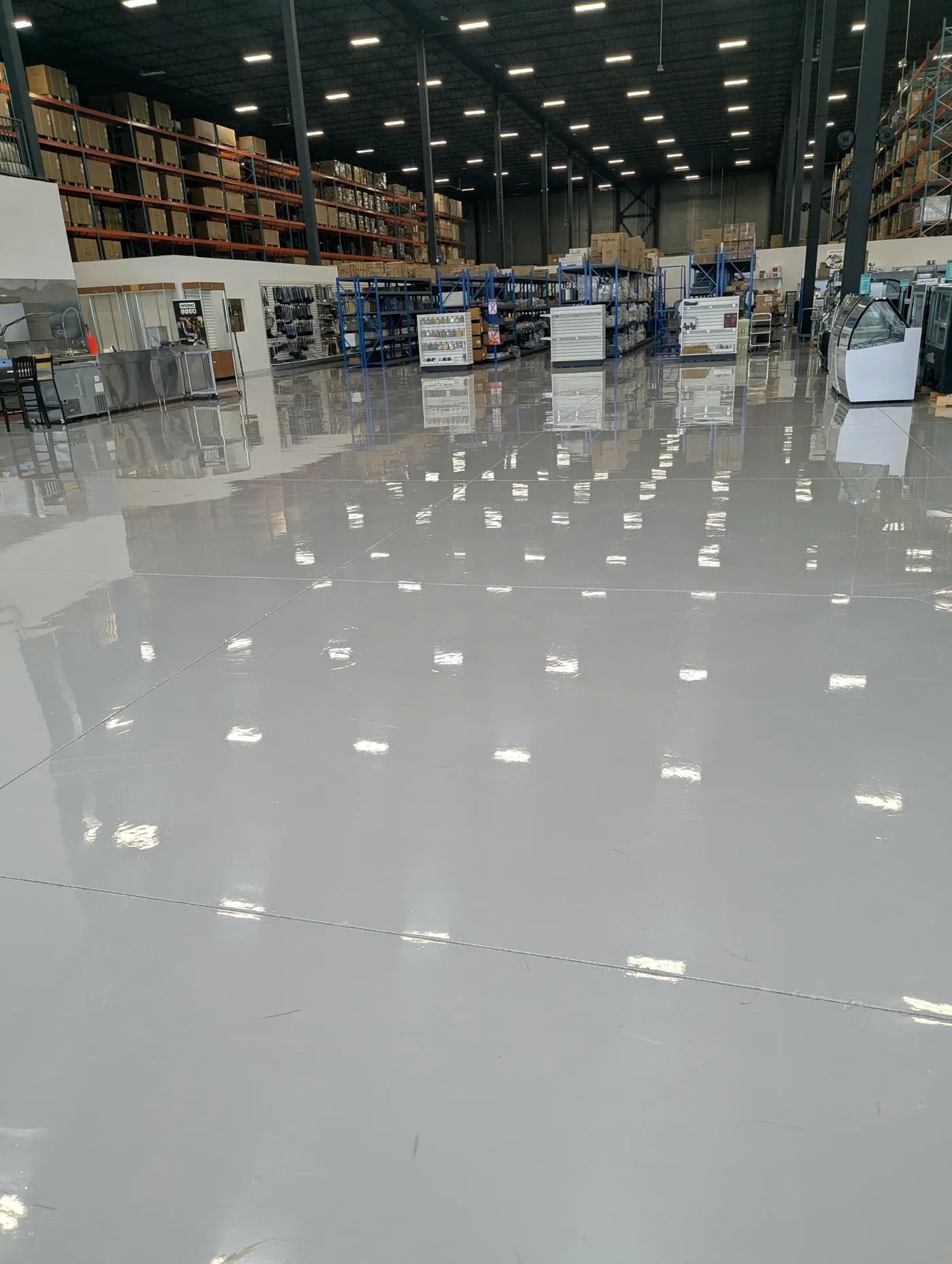
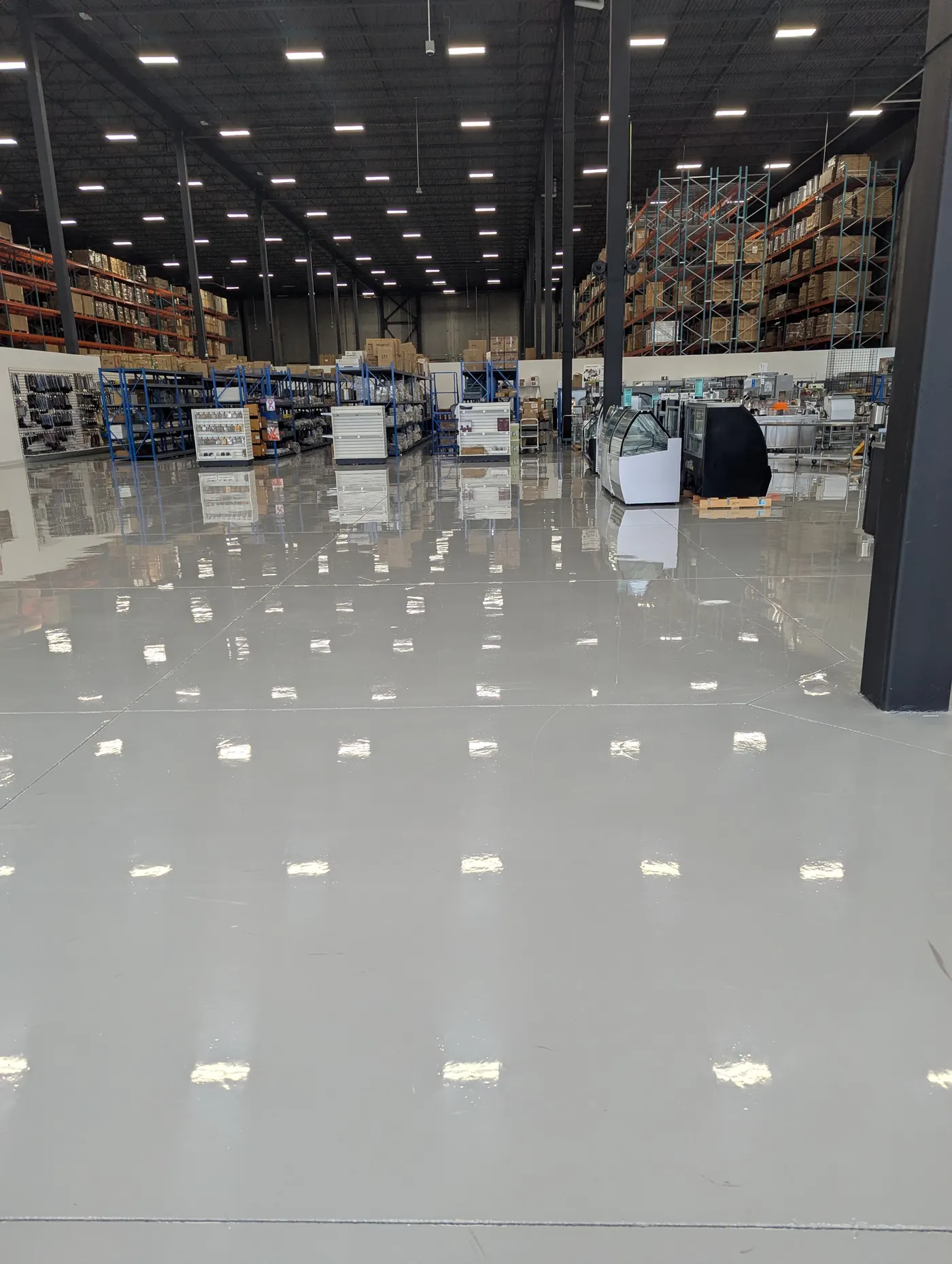
Seamless, monolithic, coved. The argument for FOD control is mechanical: remove the joints and the dusting paste and there is nothing to shed.
Aircraft gear and jack loads come from the type's maintenance manual, and the slab needs an engineer's review before a mortar system is specified over it.
A high-reflectance floor in a hangar is a working benefit, not a cosmetic one. Dropped hardware is far easier to find on a light seamless surface.
Parts washing, degreasers and aviation cleaners all go on the chemical list before the system is chosen.
Hangar doors open, temperatures drop. Some systems install below freezing, most do not, and that determines the schedule.
Data sheets, resistance results where static control is specified and warranty paperwork, in a form your quality system can file.
Burlington is our home base, which in practice means a shorter lead time and easier site visits than anywhere else we work. The industrial stock along Harvester Road, Mainway and the North Service Road is mature and generally straightforward to get into, with real dock access and room to stage. What catches people out here is the slab, not the schedule: a lot of these floors have been sealed, patched, painted and re-sealed over forty years, and all of that has to come off before anything new goes down.
Being based in Burlington means we can usually get eyes on the floor within days rather than weeks, and take moisture readings on the same visit.
Old coatings, sealers and shake-on hardeners are removed mechanically to the profile the new system needs. This is the step that decides whether the floor lasts.
We work in sections around your hours, then hand over data sheets, a maintenance sheet and a 5-year warranty on the installed system.

Twenty-seven Google reviews, a 5.0 average, and Christopher replies to every one of them personally. Being based in Burlington also means the people who quoted your floor are the people who show up to install it.
"I had the pleasure of working with Surface Coating Experts, owned by Christopher, on a project in our condominium where one of the balconies and walkways required a complete repair."
What customers mention most: garage floor installation, epoxy quality, detailed work, and a smooth process from first quote to finished floor.
Every review gets a personal reply from the owner - the after-the-job care that keeps the rating a perfect 5.0.
This is not a sales call with a clipboard. Burlington is our home base, so the assessment is quick to arrange and we already know the building stock: Harvester Road and North Service Road floors that have been sealed, patched and re-sealed for forty years, and 407 Corridor buildings where the concrete is still green. Both are workable. Both need testing first.
Free. No obligation. Usually within the week.
Prefer to talk it through? Call (905) 876-6957, Monday to Saturday, 6am to 6pm.
Tell us where the floor is and what runs on it. We will come out, test it and put a fixed price in writing.
Same service nearby: Aerospace in Oakville · Aerospace in Hamilton
We are based in Burlington, so the assessment itself is usually days away rather than weeks. What takes real time is materials on a specialist system, and the mitigation step if the slab tests wet. Getting the testing done early does not commit you to anything, it just means the date you eventually pick is a date we can actually hold.
Also see our industrial & commercial overview, epoxy flooring in Burlington and published pricing.
We are based in Burlington, so a site visit is usually days away rather than weeks. Tell us the square footage and what the floor has to survive, and we will test it and price it properly.
Free, no obligation, and you keep the written scope whether you use us or not.