
Chemical, impact and thermal resistant systems for Burlington manufacturing plants, machine shops, metal fabricators and process facilities. Specified against what actually lands on your floor, not against a generic brochure.
Free on-site assessment, usually within days because we are based here in Burlington. Written scope, fixed price, no obligation.
Plant floors do not send you an invoice. They just show up as housekeeping hours, maintenance costs and, eventually, a repair that has to happen during production.
Etched, softened or discoloured concrete has lost its top layer. That layer does not grow back, and the next spill goes deeper than the last one.
Porous, contaminated concrete holds oil and coolant no matter how often it is cleaned. That is a labour cost with no end date attached to it.
A system laid over a shake-on hardener, over slab moisture or over contamination lets go inside two years. Removing the failed coating then costs more than proper preparation would have in the first place.
Traffic segregation, contamination control and housekeeping all get scored, and the floor is the visible evidence for all three.
Burlington plants tend to be tighter footprints with equipment packed in, so the failures cluster around machine bases, pit edges and conduit runs rather than out in the open floor. Those are detailing failures, and detailing is exactly what gets cut from a cheap quote.
The expensive floor is the one you end up doing twice.
Burlington's manufacturing base runs from AXYZ Automation and Eaton Electrical to Samuel Son and Co. and WeatherTech, with clean tech names like ABB, Anaergia, Ecodyne and Umicore Autocat Canada in the mix as well. That diversity is the point for us: a metal fabricator, a catalyst plant and an electrical assembly operation need three different systems, and the only honest way to choose between them is to read your chemical list against the manufacturer's resistance chart. Most of this sits along Harvester Road, Mainway, the North Service Road and Appleby Line, where the building stock is mature and the slabs have history.
Most requested in Burlington: chemical resistant topcoats and machine base coving.
Harvester Road and the North Service Road stock dates to the 1960s through 1980s, which usually means a hard-troweled slab with no vapour retarder under it and decades of soaked-in product. The 407 Corridor and Bronte Creek Meadows are Burlington's newest inventory, where green concrete and slab moisture are the risk instead.
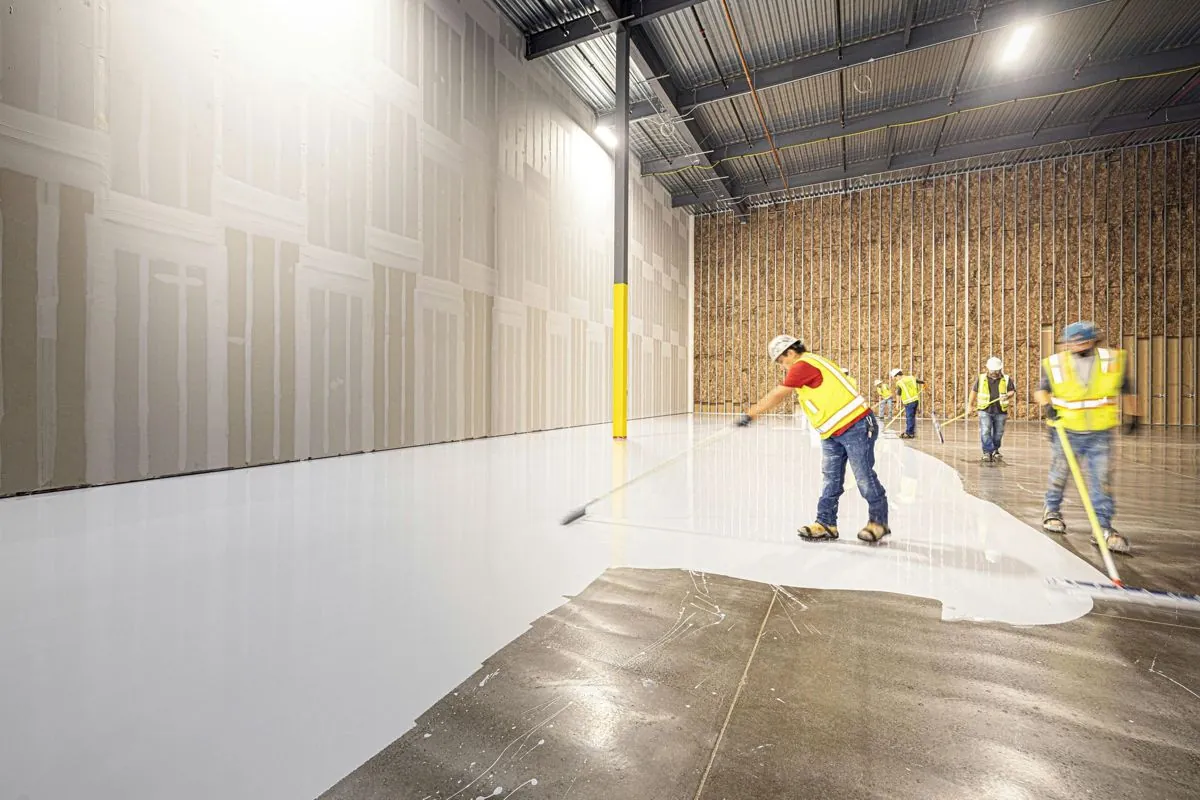
Burlington plants tend to have more compact footprints than Hamilton's, which is an advantage: we can often do a whole department in a weekend rather than phasing over a month. The trade-off is that the equipment is packed in tighter, so the detailing work around plinths, pits and conduit runs is a bigger share of the job than the open floor is. That is where the hours go, and it is worth understanding when you compare our quote against one that is priced by the square foot alone.
Every plant floor question comes back to the same three inputs: what gets spilled on it, how hot that spill is, and what rolls over it. We ask for the list first, then specify against the manufacturer's resistance chart for the exact system, which is the only place those answers actually live.
| System | Where it goes | Why it gets specified |
|---|---|---|
| Novolac epoxy | Acid handling, plating, battery rooms, chemical process bays | Published product data covers inorganic acids including 98% sulfuric, at 100% solids, with service to roughly 80°C. This is where standard bisphenol-A epoxy stops being the right answer. |
| Urethane cement mortar | Hot process, steam clean-down, foundry-adjacent, thermal cycling | Rated across roughly -40°F to 250°F with a 150°F-plus shock differential, and it moves at close to the same rate as the slab so it does not shear off under thermal cycling. |
| High-build epoxy with urethane topcoat | General production floors, assembly, packaging | The workhorse. Epoxy for build and adhesion, urethane or polyaspartic on top for abrasion, UV stability and faster return to service. |
| Static dissipative systems | Powder handling, solvent areas, electronics-adjacent lines | Where combustible dust or solvent vapour is in play, the floor becomes part of the grounding strategy rather than just a surface. |
| Machine plinth and base coving | Every equipment base, pit edge and pedestal | Coved up the plinth and sealed at the interface, so coolant and oil cannot get underneath the coating and lift it. |
A plant floor that has been running for twenty years has oil, coolant and hydraulic fluid driven down into the concrete. Grinding the surface alone does not solve that, it just exposes clean-looking concrete with contamination underneath waiting to reject the primer. Older stock needs degreasing, sometimes repeated, and a bond test before anything gets specified. This is the step most quotes skip and most failures come from.
Book a Site VisitThere is no such thing as a chemically resistant floor in general. There is a specific system with a specific resistance chart. Novolac extends the acid range, urethane handles solvent and thermal duty, standard epoxy has real limits. We ask what you run, then match the system and show you the data rather than promising broad resistance.
Read the GuidesWe work line by line and cell by cell, around fixed equipment and pits, on nights, weekends and shutdown windows. Fast-cure systems have equipment back on the floor within hours rather than days, and we coordinate with your millwrights on anything that has to be lifted or unbolted.
See PricingWe are local, so the assessment is normally days away rather than weeks. We test the slab, write the scope and give you a fixed price, and you are not committing to anything by finding out.
Aggregate-filled mortars at a quarter inch and up are the answer where dropped tooling and heavy point loads are routine, not a thicker roll coat.
Machining floors get a system chosen for the coolant chemistry in use, with texture that still grips when the floor is oily.
Ovens, quench areas, wash bays and anywhere the floor swings temperature get urethane cement rather than epoxy.
A sealed, seamless floor keeps grinding dust and swarf sweepable instead of ground into the slab.
Walkways, hazard zones, forklift routes and equipment footprints marked into the system per ANSI Z535.1 colour convention.
ASTM C579 compressive results carry roughly 15% reproducibility variance, so we do not sell you on a small psi gap between two products.
Burlington is our home base, which in practice means a shorter lead time and easier site visits than anywhere else we work. The industrial stock along Harvester Road, Mainway and the North Service Road is mature and generally straightforward to get into, with real dock access and room to stage. What catches people out here is the slab, not the schedule: a lot of these floors have been sealed, patched, painted and re-sealed over forty years, and all of that has to come off before anything new goes down.
Being based in Burlington means we can usually get eyes on the floor within days rather than weeks, and take moisture readings on the same visit.
Old coatings, sealers and shake-on hardeners are removed mechanically to the profile the new system needs. This is the step that decides whether the floor lasts.
We work in sections around your hours, then hand over data sheets, a maintenance sheet and a 5-year warranty on the installed system.
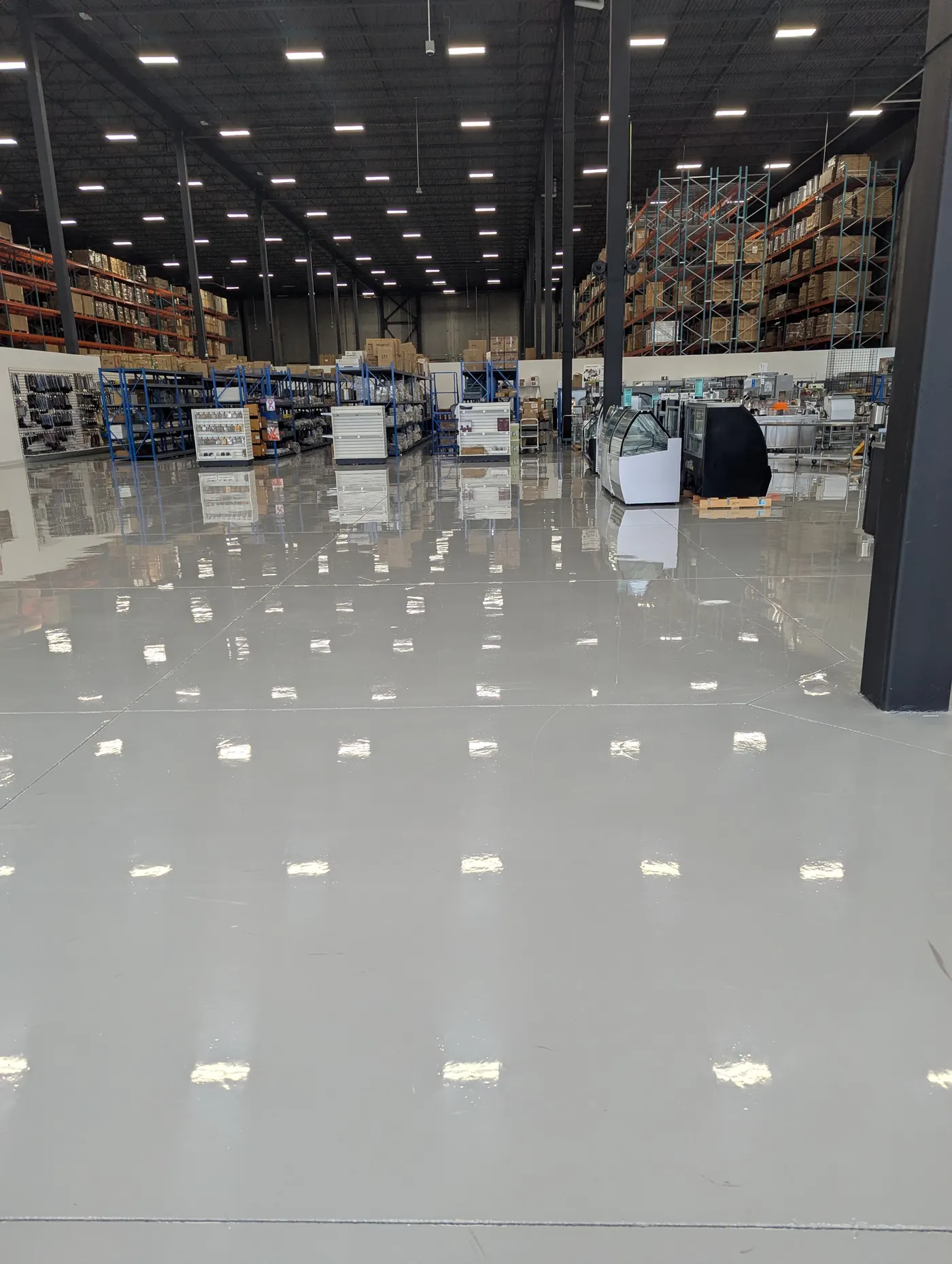
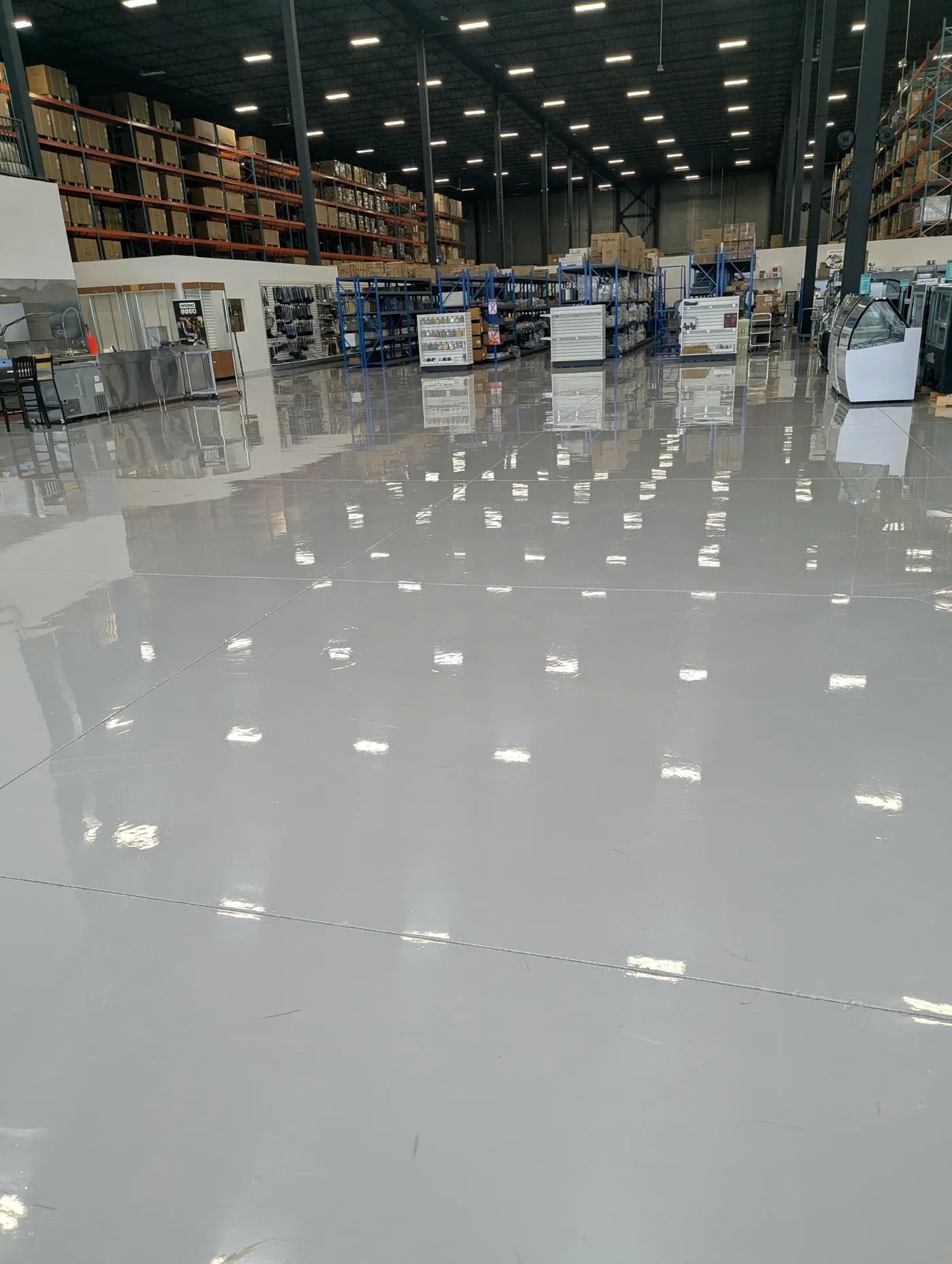
Twenty-seven Google reviews, a 5.0 average, and Christopher replies to every one of them personally. Being based in Burlington also means the people who quoted your floor are the people who show up to install it.
"I had the pleasure of working with Surface Coating Experts, owned by Christopher, on a project in our condominium where one of the balconies and walkways required a complete repair."
What customers mention most: garage floor installation, epoxy quality, detailed work, and a smooth process from first quote to finished floor.
Every review gets a personal reply from the owner - the after-the-job care that keeps the rating a perfect 5.0.
This is not a sales call with a clipboard. Burlington is our home base, so the assessment is quick to arrange and we already know the building stock: Harvester Road and North Service Road floors that have been sealed, patched and re-sealed for forty years, and 407 Corridor buildings where the concrete is still green. Both are workable. Both need testing first.
Free. No obligation. Usually within the week.
Prefer to talk it through? Call (905) 876-6957, Monday to Saturday, 6am to 6pm.
Tell us where the floor is and what runs on it. We will come out, test it and put a fixed price in writing.
Same service nearby: Manufacturing in Oakville · Manufacturing in Hamilton
We are based in Burlington, so the assessment itself is usually days away rather than weeks. What takes real time is materials on a specialist system, and the mitigation step if the slab tests wet. Getting the testing done early does not commit you to anything, it just means the date you eventually pick is a date we can actually hold.
Also see our industrial & commercial overview, epoxy flooring in Burlington and published pricing.
We are based in Burlington, so a site visit is usually days away rather than weeks. Tell us the square footage and what the floor has to survive, and we will test it and price it properly.
Free, no obligation, and you keep the written scope whether you use us or not.