
Urethane cement and epoxy systems for Oakville food plants, breweries, bakeries, dairies, meat and produce processors and commercial kitchens. Seamless, coved to the wall, sloped to drain and built to survive daily hot washdown.
Free on-site assessment anywhere in Oakville, written scope, fixed price. No obligation, and no pressure if the answer is not this quarter.
Nobody budgets for a floor until it turns into an audit finding or an unplanned shutdown. By then it is the most expensive line item in the building, and it is on somebody else's timetable rather than yours.
A cracked slab, an open wall junction or a drain throat that has been eaten out reads as a finding. Remediating under a corrective action deadline costs a multiple of doing the same work on your own schedule.
Standard epoxy specified into a hot washdown area is a recurring operating cost pretending to be a capital project. Three recoats cost more than one urethane cement system that was right the first time.
Once a coating debonds at a drain or a wall junction, washdown drives water underneath it. You cannot clean what you cannot reach, and the failure spreads sideways from that point on.
A cook line floor polished smooth by years of scrubbing is a claim waiting to happen, and the lost time is the smallest part of that bill.
In Oakville the version of this we see most is a food operation in a multi-tenant industrial building that was never designed for washdown. The drains are in the wrong places, the wall junctions were caulked rather than coved, and the slab has whatever the previous tenant left in it.
One unplanned shutdown almost always costs more than the floor would have.
Food is one of the manufacturing sub-sectors Invest Oakville lists alongside automotive, aerospace, machinery and nuclear, with Olymel among the named processors. That mix matters to us, because an Oakville food plant is often a converted or shared industrial building in Winston Park or off the QEW service roads rather than a purpose-built plant. We test the slab and check what the building did before it made food, since old process contamination is what rejects a primer. On the commercial kitchen side we work the restaurant floors in Kerr Village, Bronte and along Lakeshore, which are a different animal again: small, tight, and closed for two nights at most.
Most requested in Oakville: commercial kitchen floors and packaging hall recoats.
South Oakville's employment districts are mature and close to fully built out, so we see a lot of 1970s to 1990s slabs poured before under-slab vapour retarders were standard. North Oakville and the Highway 407 lands are the opposite problem: new concrete that is still giving off moisture. Either way we test before we quote.
The practical Oakville complication is shared occupancy. A lot of food production here sits in multi-tenant industrial buildings, which means our grinding dust, our noise and our odour are somebody else's problem too. We hoard the work area, run extraction at the grinder rather than after the fact, and clear the schedule with the property manager before we start. On the kitchen side, the constraint is almost always the grease trap and the drain layout rather than the floor itself, and we would rather find that on the site visit than on the Friday night we are meant to be pouring.
A food facility is not one floor. The cook line, the packaging hall and the blast freezer each punish concrete differently, and specifying one system across all of it is how plants end up recoating in three years.
| System | Where it goes | Why it gets specified |
|---|---|---|
| Urethane cement, 6 to 12 mm | Cook lines, washdown bays, blast freezers, bottling and CIP areas | Manufacturer data puts a 6 mm build at roughly -25°C to +80°C and a 12 mm build at -40°C to +130°C, with occasional spillage to 150°C. That is why boiling washdown does not lift it the way it lifts standard epoxy. |
| Self-levelling urethane cement, 4 to 6 mm | Dry process, packaging, warehouse side | Seamless and cleanable, tough enough for pallet and forklift traffic, without paying for a full trowelled mortar where you do not need one. |
| Broadcast quartz epoxy | Prep rooms, coolers, corridors | Texture is built into the system rather than sprinkled on top, so the slip profile survives scrubbing. |
| Novolac epoxy topcoat | Fermentation, pickling, acid and CIP chemical zones | Novolac resists inorganic acids well past where standard bisphenol-A epoxy gives up, including concentrated sulfuric exposure on published product data. |
| Integral cove base, 100 mm | Every wall and floor junction, plinths and equipment bases | Removes the 90 degree corner that product, water and biofilm collect in. This is the single most common thing we find missing on an existing plant floor. |
Steam, caustic, hot oils and animal fats will find every weakness in a floor. Published resistance data on urethane cement systems covers 50% acetic acid, concentrated lactic acid at 60°C and 100% oleic acid at 60°C. The failure mode with ordinary epoxy is rarely chemistry anyway, it is thermal movement: epoxy expands at a different rate than the slab, and a boiling washdown cycle shears the bond. Cementitious urethane moves much closer to the concrete underneath it.
Book a Site VisitThe Safe Food for Canadians Regulations, section 57, require floors that are smooth, non-absorbent and impervious to moisture, that provide or permit good drainage, and surfaces capable of withstanding repeated cleaning and sanitizing. We specify to that language and hand you the manufacturer data sheets for your PCP file. What we will not do is tell you a floor is CFIA certified, because no such certification exists, and the USDA non-food compounds acceptance programme ended in 1998. Any plant being told otherwise is being sold something.
Read the GuidesWe work nights, weekends and shutdown windows, and we section the plant so one line keeps running while another is down. Standard urethane cement grades take traffic within about 24 hours at 8°C, and rapid grades in roughly 5 hours at 10°C, which is what makes a weekend changeover realistic.
See PricingBook the free on-site assessment. We test the slab, write the scope and give you a fixed price. Finding out costs you an hour and commits you to nothing.
Falls to drain generally run between 1:100 and 1:80. Channels go near equipment, never underneath it, with prefabricated profiles at the channel edges.
ANSI A326.3 sets 0.42 wet DCOF for interior wet areas and 0.55 where oils and greases are present. We build cook lines and wet process to 0.55, and we will tell you plainly that the standard itself says DCOF does not predict whether someone slips.
Blast freezer thresholds, retort areas, steam kettles and rack washers all get a thicker build than the room around them.
Cove up the wall, cove up the plinth, seal the interface. Cleanable geometry beats a cleanable coating.
Moving joints get honoured through the system, not buried under it. Buried joints telegraph and split within a season.
Allergen zones, raw versus RTE separation and traffic aisles marked into the floor rather than taped onto it.
Oakville splits into two working realities. South of Dundas the buildings are older, tenanted and busy, so access, parking and elevator or dock time drive the schedule as much as the coating does. North of Dundas and out toward Highway 407 the buildings are newer, easier to work in, and the constraint is usually concrete that has not finished drying. We quote them differently because they are different jobs.
We come out, measure, take moisture readings and look at what the floor has been through. On south Oakville stock we assume no vapour retarder until testing says otherwise.
The quote states the system, the build thickness, the preparation method and the phasing plan, so you know which areas go down on which nights before you sign anything.
Nights, weekends and shutdown windows, sectioned so the building keeps working. Fast-cure topcoats put traffic back on a finished section in as little as 4 hours.
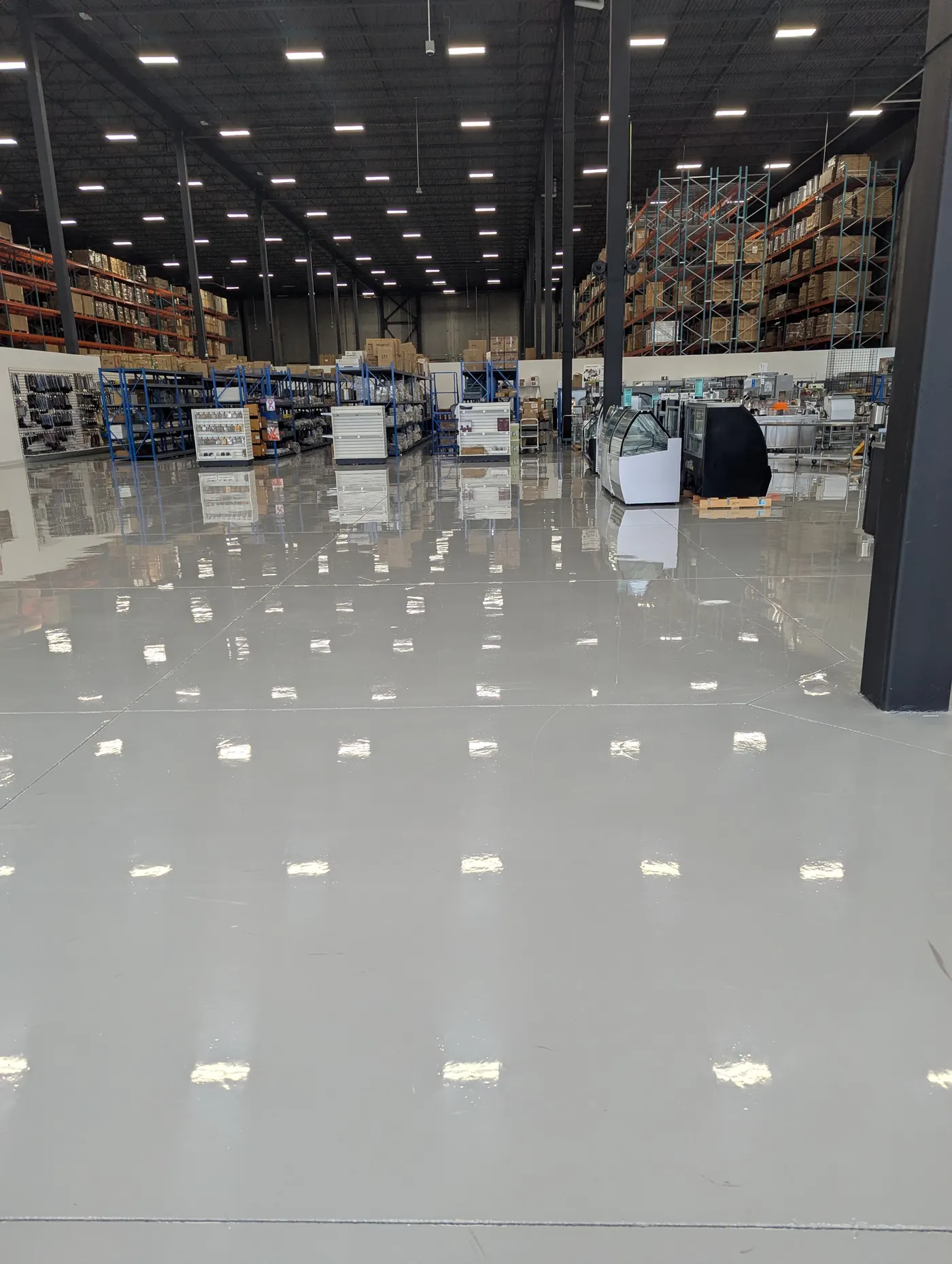
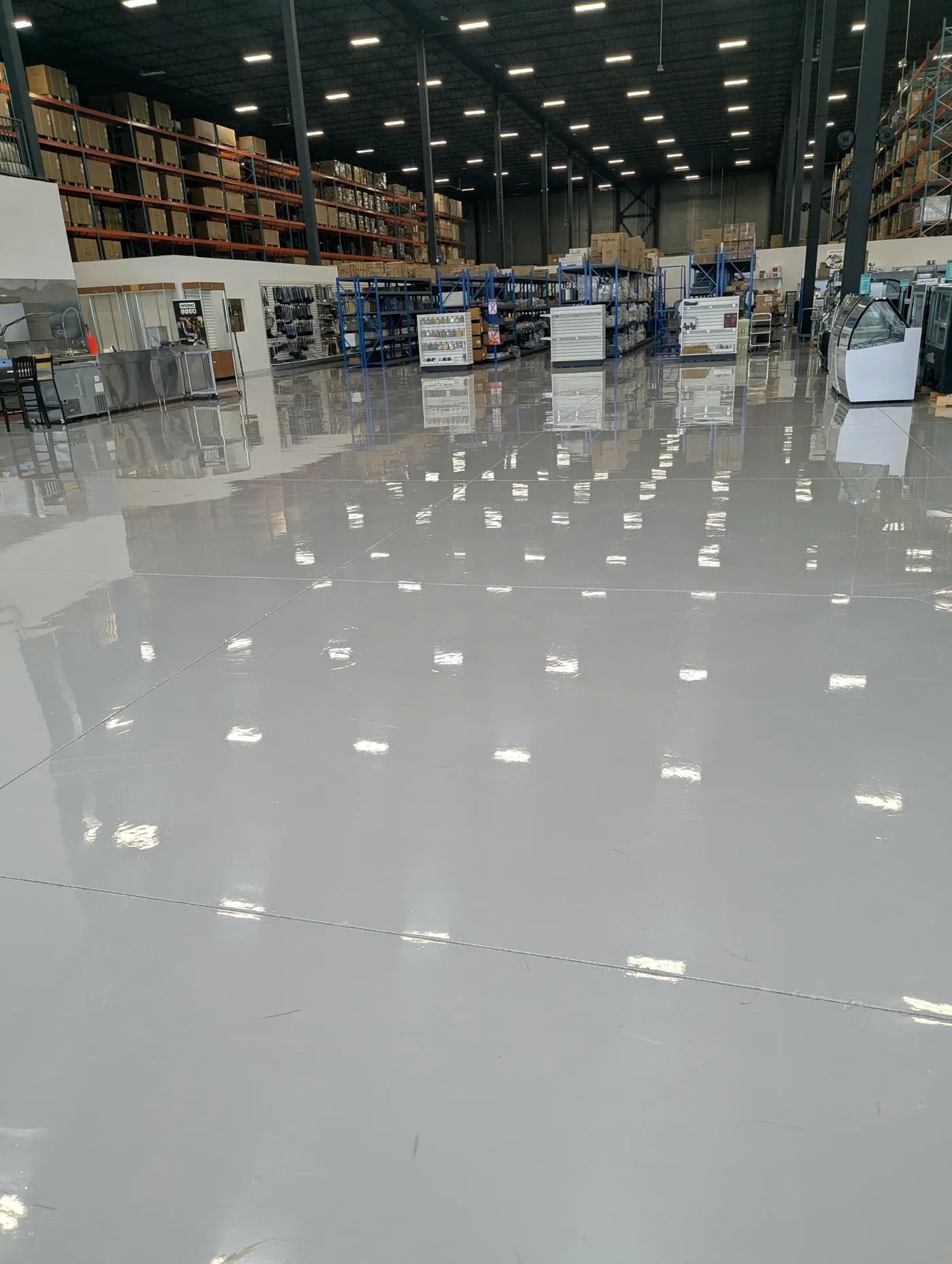
Twenty-seven Google reviews, a 5.0 average, and Christopher replies to every one of them personally. He is also the person who will be standing on your floor, which is not true of most companies quoting this work.
"I had the pleasure of working with Surface Coating Experts, owned by Christopher, on a project in our condominium where one of the balconies and walkways required a complete repair."
What customers mention most: garage floor installation, epoxy quality, detailed work, and a smooth process from first quote to finished floor.
Every review gets a personal reply from the owner - the after-the-job care that keeps the rating a perfect 5.0.
This is not a sales call with a clipboard. An Oakville building is either mature south-end stock with a slab poured before vapour retarders were standard, or a newer north-end build where the concrete has not finished drying, and those need opposite answers. The assessment is how we find out which one you have before anybody quotes a number.
Free. No obligation. Usually within the week.
Prefer to talk it through? Call (905) 876-6957, Monday to Saturday, 6am to 6pm.
Tell us where the floor is and what runs on it. We will come out, test it and put a fixed price in writing.
Same service nearby: Food & Beverage in Burlington · Food & Beverage in Hamilton
Shutdown and long-weekend windows across Oakville's industrial districts get spoken for well ahead, so if you are aiming at a particular weekend, start the conversation early rather than late. And if the slab tests wet, moisture mitigation adds material lead time. Neither is a reason to rush a decision, both are reasons to get the testing done now while it costs you nothing.
Also see our industrial & commercial overview, epoxy flooring in Oakville and published pricing.
Tell us the square footage, what runs on the floor and when the building can be quiet. We come out, test the slab and put the scope and the sequence in writing.
Free, no obligation, and you keep the written scope whether you use us or not.